About the Book:
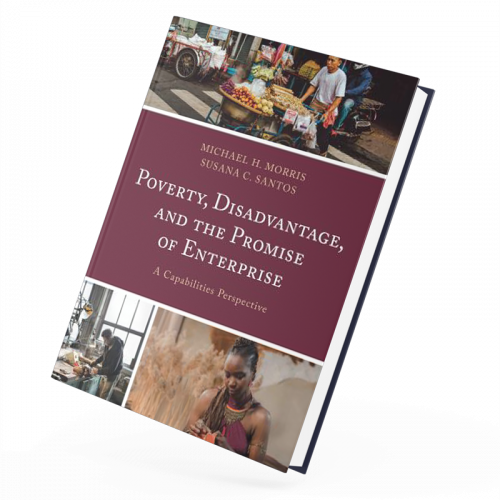
Can entrepreneurship serve as a pathway out of poverty? Can low-income people create ventures to improve their economic circumstances and enhance their lives? Poverty, Disadvantage and the Promise of Enterprise: A Capabilities Perspective argues that “it depends.” To understand the poverty and entrepreneurship interface, we must first understand poverty. Using a lens of disadvantage theory and the capabilities framework, the book explores the implications of poverty’s complex, multi-dimensional nature when starting and growing a business. Four key liabilities directly impact the opportunities these individuals can recognize, the types of ventures they create, how the businesses perform, and the impacts on the entrepreneur’s well-being. Because of these liabilities, these ventures tend to fall into what the authors call the commodity trap, where they struggle with low sales volumes and marginal profits. However, the trap is avoidable, and with the right kinds of support, the performance of these ventures can be meaningfully improved. Key design elements of a successful intervention approach and an alternative perspective on the roles of community-based entrepreneurial ecosystems and public policy are introduced. Emphasis is also placed on the critical roles of faith, hustle, and fear of failure and success.
President Review:
This book resonates deeply with me for a multitude of reasons. At its core, it delivers a profound analysis of humanity’s responsibility at a critical juncture: understanding poverty’s complexity and addressing it at its very roots. This is not merely an exercise in academic inquiry or an act of altruism—it is an imperative for all of us as global citizens. Tackling poverty is a shared responsibility, and this book masterfully articulates why entrepreneurship can serve as a meaningful pathway to achieving this goal while candidly acknowledging the challenges and nuances involved.
Mike Morris has again demonstrated why he is a luminary in entrepreneurship research. This work might well be the pinnacle of his illustrious career, as it seamlessly combines rigorous scholarship with practical insights that can shape public policy and community action. This book challenges us to rethink entrenched assumptions and inspires hope for transformative change.
Equally exciting is Susana Santos’s contribution. Her voice shines in this work, and I have no doubt she is poised to become one of the most brilliant and impactful thought leaders in entrepreneurship. Her depth of understanding and fresh perspectives make her a rising star to watch closely in the coming years.
This book is not just a read—it is a call to action. It invites us to engage more deeply with the intersection of poverty and entrepreneurship and to reimagine how we can collectively build a more equitable and empowered world.